
What Is a Validation Study?
September 10, 2026
Total cost of ownership is climbing almost daily. Fuel, parts, labour, and the cost of keeping people on site are all higher than before, all while we haven’t received any budget increases to cover it. Every component, system, or structure of a haul truck needs to at least meet its minimum, if not exceed, its planned life expectancy to make it count. This is especially true for tyres, which need to meet or safely exceed this to ensure value is extracted every cycle. Now more than ever, we need to achieve more tonnes every hour at lower cost.
Tyres are the only thing connecting the truck to the road. They absorb every decision made upstream, and they are usually the first place those “decisions” show up. Tyres make up one of the largest proportions of total cost of ownership, and poor tyre life significantly impacts that value and contributes to productivity impacts in many ways.
What actually determines how long a tyre lasts?
No single variable determines tyre life. These all play a part:
- Pressure
- Operating temperature
- Haul-road conditions
- Speed
- Haul-cycle distance
- Maintenance practices
- Vehicle condition
- The rocks nobody saw
Load underpins them all, setting the duty each variable acts on. That does not make load the answer by itself. But if a tyre review cannot describe the load conditions the tyres are working under, it leaves a technical gap at the centre of the review.
A reported payload isn’t the whole load condition
Onboard payload values feed into production reporting and loading decisions. They provide the total, plus data on load cycles, speeds, and overloading conditions. To complete a tyre review properly, your engineering teams need much more than this to improve proactive decisions, and they need all the other tyre data in one place.
Onboard systems are configured with an accuracy tolerance of an OEM guideline of +/- 8%, set per system and per site rather than as a single industry figure. The accuracy band the onboard system is configured to varies and also relies on base inputs, such as known EVW, to be accurate and up to date. These systems can’t accurately tell the engineering team:
- How the load sat on the truck: front-to-rear axle bias
- Payload compliance
- Whether any tyre position is exceeding its rated load safety factor, and what that meant for the duty each tyre actually carried
- TKPH, since it’s a calculation that can’t be relied on if you’re only getting an estimate from payload and speed alone
What the site is left without is the physical reference needed for a tyre or load-management review to manage haul truck tyres with sufficient accuracy and confidence, and to validate it within the one location.
When records, operating experience, or wear trends don’t agree, the site may need to test a defined question.
- Is the payload reference we rely on every day appropriate for the truck, tyre selection, and our current operating conditions?
- Does onboard payload variance hide a load-distribution reality we only see after a tyre fails early or truck reliability has already dropped?
Answering either question takes an independent physical reference. Without one, the review runs on history and opinion with no room for prediction or proactivity.
Independent physical evidence gives the review a better starting point
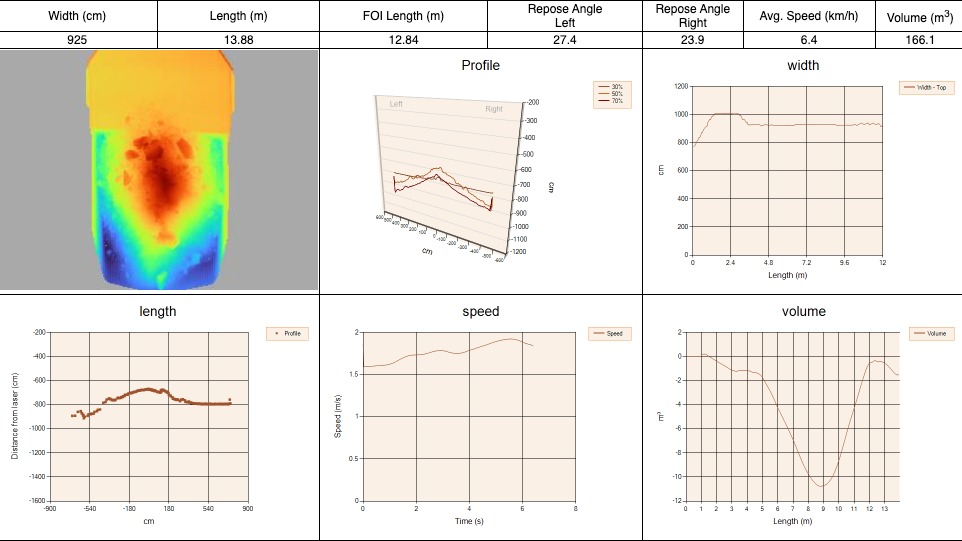
EYEMINE, the independent source of truth for the mining sector, independently measures what is physically happening at the truck, scans the back of the tray, and combines this information in real time.
- EYE-WEIGH establishes physical weight, payload, tare, and selected load-condition evidence using an agreed method.
- EYE-VALIDATE creates an on-site evidence set to help our customers answer not only these simple questions but many others to understand what is happening with their fleet in a real “Current State” position.
Most sites already hold more tyre data than they can use, via multiple individual reporting systems such as:
- Pressure
- Temperature
- Tread depth and profile scans
Each answers its own narrow question, on its own timeline, in its own report. The load evidence is usually the piece missing from the pile.
Where those inputs are available and the connections are active, EYE-ANALYSE can bring them together with our measured and scanned load so teams review one evidence set instead of four partial ones. Teams can then communicate the outcomes to all responsible teams, such as maintenance planning, haul road condition, truck-to-excavator allocation, and the scope of the next shutdown.
Talk to EYEMINE about tyre and load evidenceKeep the tyre-analysis boundary clear
EYEMINE gives your tyre engineering teams measured load evidence and combines individual sources to form a solid foundation for future-state tyre performance. Prediction, diagnosis and tyre-life calculation stay with those teams, but they do that work against a physical reference instead of an assumed one. EYEMINE provides the physical evidence behind that discussion and helps bridge the gap between data and action as efficiently as possible.
From Data To Action
Most sites don’t validate them independently. They rely on the onboard total and configure inputs such as baseline EVW, which drift over time. EYE-WEIGH measures payload, tare and EVW at the truck, and EYE-VALIDATE compares the results against your approved targets and baselines. Every gap is shown with supporting evidence and handed to your engineering team for review.


Onboard systems report a total within a site-configured tolerance. They can’t show accurate axle bias or per-tyre load, so a truck can read “in tolerance” even when one tyre position runs above its rated load. EYEMINE measures axle distribution directly and, with the fitted tyre rating and axle-to-tyre mapping, shows the load at each tyre position against its rating.
Today, pressure, temperature, tread and profile data sit in separate reports on separate timelines, usually with no load evidence. Where connections are active, EYE-ANALYSE matches those inputs to EYEMINE’s measured and scanned load, giving each truck a single evidence set with every source labelled. Tyre engineers can then calculate TKPH from actual tyre-position load, not a payload and speed estimate, and share a single basis with maintenance, haul road, loading and shutdown planning.
Tyre life consumed by load conditions we can’t see. Payload capacity lost to EVW drift. Tonnes lost on every load to unmeasured payload gaps. Maintenance that stays reactive, finding problems only after an early tyre failure or a drop in reliability. EYEMINE measures the physical side in tonnes per load, shift and year, giving the site a clear basis to act.
Conclusion
Payload evidence belongs in the tyre-management conversation because everything else in that conversation depends on it being right. If the operation needs a better physical reference for a payload, tare or load-condition decision, start with the operating question. EYEMINE can then define the evidence required for an EYE-VALIDATE scope.
Talk to EYEMINE about tyre and load evidenceReference: Safety and maximisation of tyre life: Resources Safety & Health Queensland (RSHQ), on load conditions and axle bias as factors in premature haul truck tyre wear.